

- Canada announced an Express Entry category for physicians, which was set to launch in early 2026. It requires at least one year of paid Canadian work experience in the last three years as a general or family physician, surgical specialist, or clinical or laboratory medicine specialist.
- The usual Express Entry rules still apply: an approved English or French test, an Educational Credential Assessment for degrees earned outside Canada, and eligibility under a program such as the Federal Skilled Worker Program or Canadian Experience Class.
- Physicians without one year of Canadian experience may still be invited through the broader healthcare occupations draws, introduced in 2023, which count work experience gained in Canada or abroad.
- The government also announced plans to reserve 5,000 additional provincial nomination spots for licensed doctors with job offers, on top of regular PNP allocations, with work permits for nominees processed in about 14 days.
- Doctors abroad must first get licensed by a provincial medical regulatory college and obtain a work permit, such as an IEC Working Holiday, Francophone Mobility or LMIA-based permit. An open work permit alone does not allow you to practise medicine.
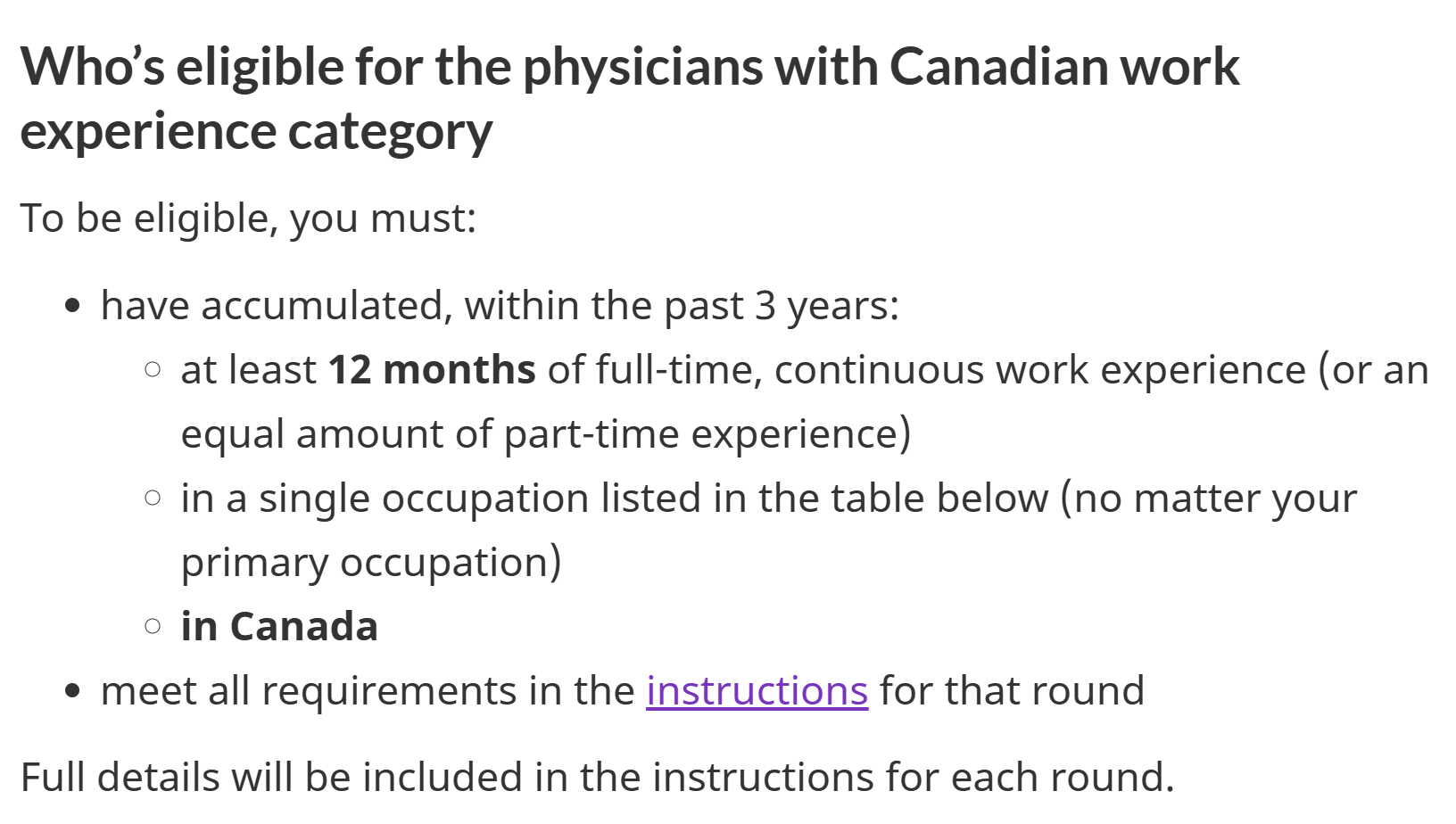
This dedicated pathway is designed to retain foreign-trained doctors already working in Canada by offering them a clearer route to permanent residence. To qualify, candidates must have at least one year of full-time (or equivalent part-time) paid work experience in Canada as a physician within the last three years. Importantly, only certain medical occupations are eligible. These include:
- General practitioners and family physicians – e.g. family doctors, general practice physicians, public health physicians, and even those providing care via telemedicine.
- Specialists in surgery – e.g. surgeons of various specialties such as general surgeons, orthopedic surgeons, pediatric surgeons, plastic surgeons, neurosurgeons, etc.
- Specialists in clinical and laboratory medicine – e.g. internal medicine specialists, cardiologists, neurologists, anesthesiologists, pathologists, and other non-surgical specialist doctors.
If your job falls under one of these categories (which correspond to specific physician NOC codes), it can count toward the required one year of Canadian experience for this new program. Additionally, having a Doctor of Medicine (MD) degree is advantageous for Express Entry – it’s considered a professional graduate degree (equivalent to a Master’s level credential for immigration purposes), which can give you higher points in the Comprehensive Ranking System.
As noted below, physicians (including those without one year of Canadian experience) may still qualify under the Healthcare and social services occupations draws. Learn more about Express Entry here.
Express Entry Requirements Still Apply
It’s important to note that this physicians-focused draw is category-based, meaning all the usual Express Entry rules still apply. Being a doctor doesn’t exempt anyone from meeting the standard criteria of Express Entry. Applicants will still need to:
- Prove Language Proficiency: You must take an approved English or French language exam (such as IELTS, CELPIP, or TEF) and meet the minimum language requirements.
- Obtain Educational Credential Assessment (ECA): If you earned your medical degree or other qualifications outside Canada, you’ll need an ECA from an approved body (for physicians, typically the Medical Council of Canada or another designated agency) to verify your education level.
- Meet Other Eligibility Factors: You should qualify under one of the existing economic immigration programs managed by Express Entry (such as the Federal Skilled Worker Program or Canadian Experience Class). This involves factors like having sufficient work experience, education, settlement funds (if required), and clean police certificates for any country you’ve lived in.
All of the usual documentation – employment reference letters, police clearances, medical exams, etc. – will be required as part of your permanent residence application. In short, physicians must fulfill all Express Entry criteria; the new category simply prioritizes issuing Invitations to Apply (ITAs) to those who meet the criteria and have Canadian work experience in the specified medical occupations.
Healthcare Category vs. Physicians Category: What’s the Difference?
This isn’t the first time IRCC has targeted healthcare professionals in Express Entry. In 2023, Canada introduced category-based draws for healthcare occupations, which included doctors alongside nurses, pharmacists, and other health professionals. What’s new for 2026 is that physicians now have a separate category exclusively for them, focused on those with Canadian experience. In fact, doctors will effectively be eligible under two categories now:
- Healthcare Occupations category: A broader category that has been inviting healthcare workers (including physicians) based on their work experience, regardless of whether that experience was in Canada or abroad. This means an international doctor without one year of Canadian experience could still potentially receive an ITA under the general healthcare draws (assuming they meet the criteria and their Comprehensive Ranking System score is competitive).
- Physicians with Canadian Work Experience category: A narrower new category specifically for doctors who have at least 12 months of Canadian work experience in the eligible physician roles. This is the category launching in 2026, meant to provide a direct pathway for doctors already here and practicing. Because it’s limited to physicians (and excludes other health occupations), the competition is only among foreign-trained doctors, which is expected to result in a lower CRS cut-off score compared to the broader healthcare draws or all-program draws. In other words, this new category should make it easier for eligible doctors to be selected, even if their age or other factors have kept their scores modest.
Why is this significant? Many physicians currently in Canada on temporary status (such as those on work permits) have found it challenging to get ITAs in regular draws or even in the general healthcare draws. Older physicians, for example, lose points for age under Express Entry’s scoring system, and those with a spouse often have slightly lower scores than if they were single. Under the new doctor-specific category, such candidates won’t be competing against younger nurses or other professionals with skyrocketing points – they will be ranked against fellow physicians, leveling the playing field. This targeted approach recognizes the value of retaining doctors who are already contributing to Canada’s healthcare system, and it could substantially improve the chances of these physicians to obtain permanent residence.
Another notable aspect of the announcement is that the Canadian government plans to reserve 5,000 additional provincial nomination spots for physicians. Provinces and territories will get these extra 5,000 slots to nominate licensed doctors with job offers for permanent residence, on top of their regular Provincial Nominee Program (PNP) allocations. Those nominated doctors will also benefit from expedited work permit processing (in about 14 days) so they can either continue or begin working in Canada while their PR is in process. This shows a significant commitment to bringing in more doctors. However, given the strict licensing and experience requirements, it remains to be seen whether IRCC will actually find 5,000 qualified physicians to fill those spots in the short term. The pool of internationally trained doctors who are already licensed and working in Canada is relatively limited, so the uptake of these programs will depend greatly on how many new doctors can enter the system and gain that coveted year of experience.
How Can Foreign-Trained Doctors Get Canadian Work Experience?
The new Express Entry category is fantastic news if you’re already working in Canada as a doctor. But what if you’re a physician abroad who wants to take advantage of this pathway? The key hurdle is that you need to gain that one year of Canadian work experience as a physician, which means you must become licensed to practice in Canada and obtain a work permit for a medical job here. This process can be challenging, but there are a few routes foreign physicians can consider to come to Canada and work towards that year of experience:
- Working Holiday Visa (International Experience Canada): If you are under 30 (or 35 for certain countries) and a citizen of a country that has a youth mobility agreement with Canada, you might be eligible for an open work permit through the Working Holiday stream of International Experience Canada (IEC). This is an open work permit that doesn’t require a job offer in advance. It can be an attractive option for young doctors from countries like Ireland, Australia, the UK, and others. However, keep in mind: an open work permit alone doesn’t let you work as a physician unless you are licensed by the medical regulatory authority in the province you want to practice. So, while the Working Holiday visa can get you into Canada and allow you to work in general, you would still need to go through the medical licensing process before you can actually practice medicine. Some doctors might use this route to come to Canada, complete licensing requirements or exams while doing other work or observerships, and be ready to start a medical job once fully licensed.
- Francophone Mobility Program: Canada offers a special work permit stream for French-speaking skilled workers called Mobilité Francophone. If you speak French at an intermediate level or above and have a valid job offer as a physician outside the province of Quebec, you could qualify for a Francophone Mobility work permit. This work permit is LMIA-exempt (meaning the employer doesn’t need to go through the Labour Market Impact Assessment process), which makes it faster and simpler for an employer to hire you. Many Canadian provinces are eager to recruit francophone doctors for bilingual or francophone communities. Important details: you will need a job offer from a Canadian hospital, clinic, or health authority, and you must meet the language criteria (usually proven by a French language test or being a national of a francophone country). As with any physician job, you must also secure the provincial medical license before you can actually practice. The Francophone Mobility program can be a great pathway to get a foot in the door with a specific employer who is willing to hire you, after which you can start earning your Canadian experience.
- Employer-Sponsored Work Permit (LMIA-based): Another common route is for a Canadian employer (such as a hospital, regional health authority, or private clinic) to sponsor you for a work permit by obtaining a Labour Market Impact Assessment. An LMIA is a document that shows no Canadians or permanent residents are ready and available to fill the position, allowing the employer to hire a foreign physician. Some regions in Canada that face doctor shortages actively recruit internationally trained doctors and will handle the LMIA process for you. Once an LMIA is approved, you can apply for a closed work permit tied to that employer. Again, you’d need to have the appropriate medical license for the province to be approved to practice. The advantage of an LMIA-backed work permit is that it’s not limited by age or nationality (unlike the Working Holiday), and it doesn’t require French (unlike the francophone stream) – it’s purely based on the employer’s need and your credentials. The downside is the process can take time and effort, and it requires an employer willing to go through the paperwork to bring you on board.
Medical Licensing Note: In all the scenarios above, a critical step is obtaining your Canadian medical license. Each province and territory in Canada has its own medical regulatory college, and internationally trained doctors must meet strict requirements to get licensed – these typically include passing exams (like the MCCQE and NAC-OSCE for general practitioners), possibly completing a practice readiness assessment or having certain postgraduate training, and proving your qualifications. The licensing hurdle is often the toughest part of practicing in Canada. The good news is that some provinces are making this process easier, especially for doctors trained in countries with similar standards. For example, if you’re already a licensed physician in the United States, certain provinces (such as Ontario and Nova Scotia) have recently introduced more streamlined licensing pathways. U.S.-board-certified doctors can sometimes get full licensure in those provinces without having to start from scratch on exams or supervision that other international medical graduates might require. This means that American-trained doctors may find it faster and simpler to become licensed in parts of Canada, which in turn makes it easier to obtain a work permit and begin working. (Other provinces are exploring similar measures – for instance, Alberta has piloted a program to waive some licensing requirements for doctors from the US, UK, Ireland, and Australia.)
Our experience
Marin Immigration Law has long supported physicians navigating the Express Entry system, well before the introduction of the new 2026 category for those with Canadian work experience. Their work includes assisting family doctors, internal medicine specialists, psychiatrists, psychologists, and other clinical professionals with tailored immigration strategies. This includes applicants both with Canadian work experience and those applying from abroad, ensuring each client’s credentials and pathway are optimized for success within Canada’s economic immigration programs.
Disclaimer: This blog is general information only, not legal advice, and may be incomplete or out of date. Laws change often. For advice on your situation, consult a qualified lawyer.
About our team
Five lawyers, a genealogist and a research team, all working on the same files.
Our lawyers have clerked at the Federal Court, decided claims at the Immigration and Refugee Board, served in Canada's foreign service and worked in the immigration groups of leading national firms. Kendra Gaede, our genealogist, chairs the Manitoba Genealogical Society's Research Committee and knows records from Quebec and Acadia to the Prairies. She leads the researchers who trace your family line and find the records that prove it.
2012 to 2016
Cédric Marin, our founder, studies civil law and common law at the University of Ottawa.
2017 to 2022
He clerks at the Federal Court of Canada, decides refugee claims and appeals at the Immigration and Refugee Board, and earns a Master of Laws.
2023
He opens Marin Immigration Law in Ottawa.
2025
Bill C-3 comes into force, and many more families with Canadian roots can claim citizenship.
2026
Four associate lawyers, a genealogist and a research team join, and we move into our office at 280 Albert Street.
Today
About 15 people, in Ottawa and across Canada.