When you apply for a proof of Canadian citizenship certificate for a child, one requirement trips up more parents than any other. IRCC asks for two pieces of identification for the applicant, both showing the child's name and date of birth, with at least one carrying a photo. For an adult this is routine. For a young child it often is not, because many minors hold only one document with a photo, their passport, and very little else in their own name.
This guide explains exactly what identity documents a child needs for a Canadian citizenship certificate, what counts and what does not, and what to do when your minor has only a passport. It reflects the current proof of citizenship application and the way these files are handled in practice.
The identity rule for a proof of citizenship application
The instruction guide is specific. Two pieces of valid identification are required to establish the applicant's identity. Both documents must show the person's name and date of birth, and one of them must include a photo. This rule applies to applicants of every age, which is why it can be awkward for children who simply do not carry the kind of identification adults accumulate over time.
When you are applying for a minor, all of the questions and requirements are about the child, not the parent. The identification has to belong to the child. A parent's driver's license or passport does not satisfy the requirement, even though the parent is the one completing and signing the application.
What we do in practice when a child has only a passport
The guide lists the standard documents, but it does not spell out what tends to satisfy an officer when a child genuinely has nothing beyond a passport.
Based on the files we handle, and on the additional document requests we have received from IRCC, records such as a child's immunization or vaccination record, a school or daycare registration card, and a provincial health insurance card have been used to help establish a minor's identity alongside the passport. These are documents most parents already have at home or can obtain quickly from a school board, a clinic, or a provincial health authority, which makes them a practical way to round out a child's identity evidence when a second photo identification does not exist.
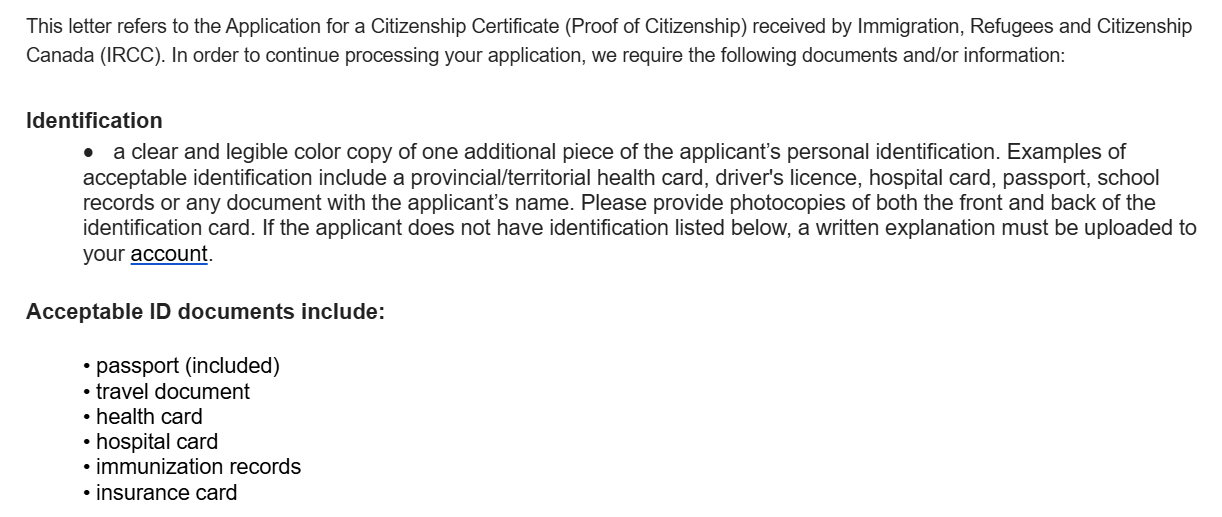
Our usual approach is straightforward. We submit the passport, we add one or more of these supporting records to confirm the child's name and date of birth, and we include a short explanation letter that addresses the missing second photo identification directly. Regardless, we add these documents going forward. All copies are provided in clear colour, since poor quality scans are a frequent reason applications are returned.
Why minors are different
Most adults can produce two pieces of identification without thinking, often a passport and a driver's license. Children usually cannot. A young child may have a passport, which conveniently carries a photo, but rarely holds a second piece of government identification, and almost never a second piece with a photo. Teenagers sometimes have more options, but for infants and younger children the passport is frequently the only formal photo identification that exists.
IRCC anticipates this gap. The guide states plainly that if you are applying on behalf of a minor who does not have two pieces of identification, or who does not have a photo identification, you should include an explanation letter with the application. In other words, the rule bends for children, provided you set out the situation clearly and submit what the child does have.
Documents IRCC accepts to establish a child's identity
The acceptable identity documents are government issued records that show a name and date of birth. Examples include a passport, a provincial or territorial health insurance card, a driver's license for older minors, an age of majority card, a certificate of Indian status, and similar documents. For a child, the passport usually covers the photo requirement, and the task becomes finding a credible second document that confirms the child's name and date of birth.
It is worth knowing what does not count. Birth certificates, Social Insurance Number cards, and bank or credit cards are not accepted as identification for this application, even though a birth certificate is essential elsewhere in the file as proof of the parent and child relationship. Keeping these two roles separate, identity on one hand and proof of lineage on the other, avoids a common mix up.
How to write the explanation letter for a minor
The explanation letter does the work that a second photo identification normally would. It does not need to be long, but it should be clear. A strong letter states that the application is for a minor, identifies the documents being submitted to establish the child's identity, and explains plainly that the child has no second piece of photo identification beyond the passport because of their age.
Naming the specific supporting documents you are relying on, such as an immunization record or a school registration card, helps the officer connect the explanation to the evidence in front of them. The goal is to remove any guesswork so the file can move forward without a request for more information.
Children applying from outside Canada
If the child lives outside Canada and cannot provide Canadian identity documents, IRCC accepts foreign government issued documents that are equivalent to the Canadian examples. The same identity logic applies, two pieces showing name and date of birth, one with a photo where possible, supplemented by an explanation letter for a minor who falls short. If a foreign document is not in English or French, it must be submitted with a translation and an affidavit from the translator, who cannot be the applicant or a family member.
Do not forget the citizenship photos
Identity documents are separate from the citizenship photos, and both are required. The application must include two identical printed citizenship photos that meet IRCC's specifications. Photos that do not meet the specifications are one of the simplest and most avoidable reasons a children's application is sent back, so it is worth taking the specifications sheet to the photographer and confirming the size and format before you submit.
Frequently asked questions
My child only has a passport. Is that enough?
A passport alone usually does not meet the two piece requirement, but you are not stuck. You can pair the passport with a second document that confirms the child's name and date of birth, such as a health insurance card, an immunization record, or a school registration card, and include an explanation letter noting that the child has no second photo identification. That combination is commonly accepted.
What if my child has no photo identification at all?
IRCC's guidance specifically allows for minors who do not have photo identification. Submit the documents the child does have to establish name and date of birth, and include an explanation letter that states the child has no photo identification because of their age. The explanation letter is the key piece that lets the application proceed.
Does a birth certificate count as identification?
No. A birth certificate is not accepted as identification for this application, even though it is important elsewhere in the file as proof of the parent and child relationship. Use it to establish lineage, not identity.
Can I use my child's health card or immunization record?
A provincial health insurance card is among the documents IRCC lists as acceptable identification. An immunization record is not on the standard list, but in practice it has been accepted to help establish a minor's identity, particularly alongside a passport and an explanation letter. Both are worth gathering.
What about a newborn or infant with very few documents?
Infants are the clearest example of why the explanation letter exists. Submit whatever the child has, often a passport plus a health card or an immunization record, and explain in the letter that no further identification exists given the child's age. The combination of available documents and a clear explanation is what IRCC is looking for.
Disclaimer: This blog is general information only, not legal advice, and may be incomplete or out of date. Laws change often. For advice on your situation, consult a qualified lawyer.