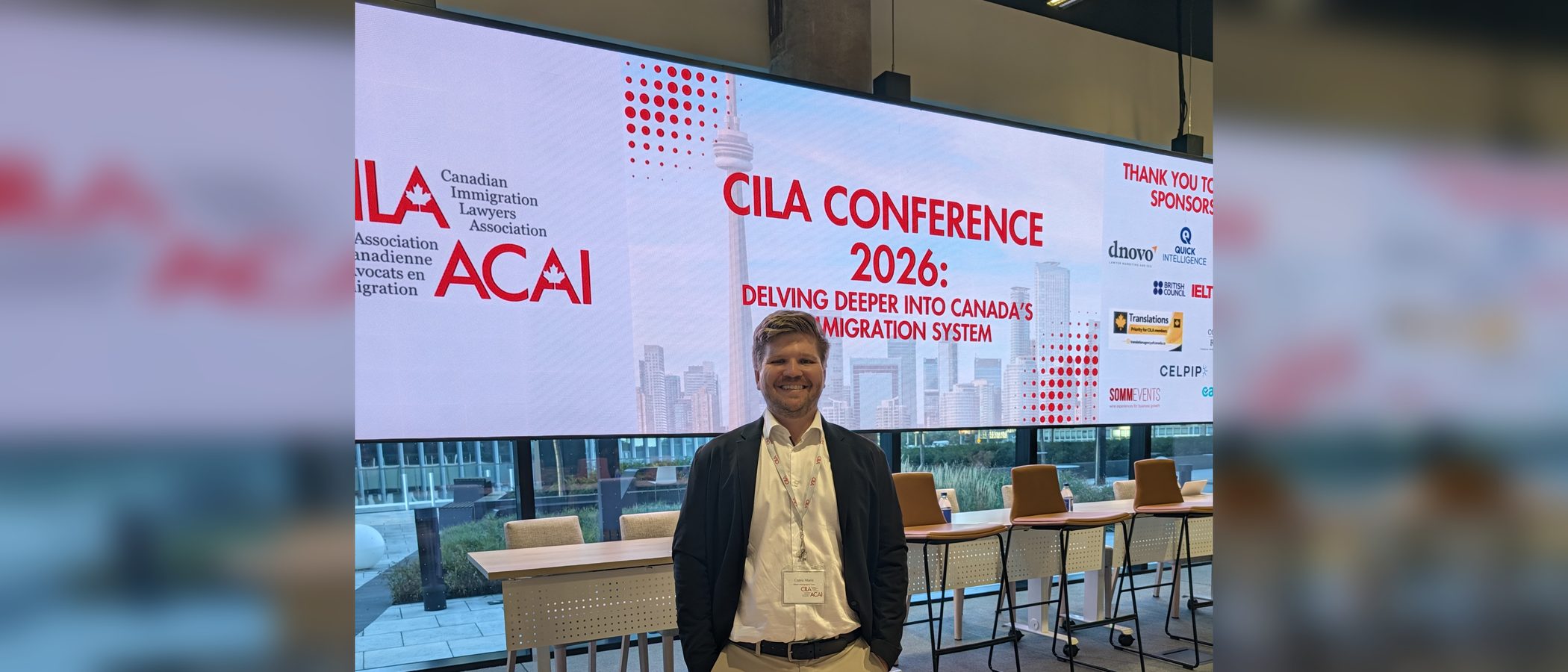

Cédric Marin at the CILA Conference 2026 in Toronto.
While almost every other part of Canada's immigration system is shrinking, citizenship is growing. That was the clearest message from IRCC's citizenship branch at the Canadian Immigration Lawyers Association (CILA) Conference 2026, held in Toronto on October 5, 2026.
Stephanie Jay-Tosh, Acting Senior Director, Citizenship at IRCC, joined the opening plenary on the top changes of 2026 and answered questions from the floor. Below are the points that matter most for people claiming Canadian citizenship by descent under Bill C-3, and what we take from them as citizenship and immigration lawyers.
Six highlights from IRCC's citizenship branch
1. Over 300,000 citizenship applications are in the queue, grants and proofs combined
IRCC's citizenship inventory now sits at a little over 300,000 applications. That is a combined figure for the two main types of citizenship applications: grants, where a permanent resident applies to become a Canadian citizen, and proofs, where a person who is already a citizen, including by descent, applies for a citizenship certificate. It is not a count of citizenship by descent files alone. If you have seen a lower number on IRCC's website for proof of citizenship applications, that is why. Citizenship by descent claims fall on the proof side. Unlike permanent and temporary residence, citizenship by descent is not subject to levels targets or intake caps, because it is citizenship by operation of law. Demand rose steadily after Bill C-3 came into force on December 15, 2025, and IRCC says processing times have been affected as a result.
2. Three groups are applying for proof of citizenship
IRCC described its proof of citizenship applicants in three groups: people born in Canada or naturalized who want a certificate, people born abroad to a Canadian parent (the first generation), and people newly eligible under the C-3 rules. The third group is the one driving growth, with several thousand new citizenship by descent applications arriving each month.
3. First in, first out, with triage for complex files
IRCC processes applications first in, first out. It also triages by complexity, so that files needing more evidence or more senior decision-makers go to the right officers. IRCC is training new citizenship decision-makers, who are trained separately from immigration officers, and moving them toward more complex files as they gain experience. Heavy reliance on paper applications adds manual intake work.
4. Most multi-generation files are moving, but some are on hold
Files carried over from the interim measure that preceded Bill C-3 were moved into the proof of citizenship stream. Asked whether a large group of multi-generation cases had been set aside, IRCC said it is not holding back multi-generation applications as a whole. A very small number of complex, historic claims are on hold for further review, and IRCC says it tells applicants when their file is one of them.
5. Evidence must come from the source
This was the most practical message of the day. IRCC wants documents that are authentic, reliable and come from the body that created or keeps the record, such as a vital statistics office or an archive. It will not accept screenshots from Ancestry, FamilySearch or other genealogy sites as primary evidence. IRCC was careful to say it is not dismissing those sites; they are useful for finding records, not for proving them.
We asked IRCC directly why officers increasingly require Quebec to reissue birth certificates for births in the 1870s and 1880s, when the contemporaneous baptism record held at BAnQ is publicly available. IRCC's answer: a baptism record is secondary evidence of birth. It can be included, and officers may follow up where they have questions. We explain how we handle these requests in our post on Quebec birth certificates for citizenship by descent.
6. Online filing is a goal, with no date
Lawyers pressed for online filing of citizenship by descent applications and representative access to the citizenship portal. IRCC called a digital-first approach its goal for every line of business and said this is on its radar, but gave no timeline.
IRCC also addressed discretionary grants under subsection 5(4) of the Citizenship Act (statelessness, special hardship, or exceptional services to Canada). Volumes remain low and each request is decided case by case. Practitioners on the panel were blunt that these grants are very hard to obtain.
What this means if you are applying
Get records from the official source. Order birth, marriage and death records from the government office or archive that holds them. Use genealogy websites to locate records, then obtain the record itself. A file built on source documents is less likely to draw follow-up requests. Our post on lessons learned from our recent files sets out what a complete package looks like.
For old Quebec births, file both. Our practice is to submit the contemporaneous act from the civil register held at BAnQ, and also apply for a certificate from the Directeur de l'état civil. IRCC's answer confirms why: some officers will ask for the certificate, and having it ready avoids delay.
Expect long waits, and plan around them. With an inventory above 300,000 and new files arriving every month, apply as soon as your documents are ready. Your place in the queue depends on when IRCC receives a complete application.
A pending application is not proof of citizenship at the border. CBSA officers on the border panel confirmed that, without documentary proof of citizenship, a person will be treated as a foreign national at a port of entry. The same applies inland: anyone in Canada on a work or study permit should keep extending their status until their citizenship certificate is issued.
Talk to a citizenship lawyer
Marin Immigration Law is an Ottawa-based citizenship and immigration law firm focused on citizenship by descent under Bill C-3. Our lawyers and staff genealogist help clients build applications on source documents, from the Canadian-born ancestor down to the applicant. If you think you may have a claim, book a consultation and we will review your lineage and the evidence it needs.
This article is general information, not legal advice. It reflects remarks made at the CILA Conference on October 5, 2026, and IRCC policy may change.
Disclaimer: This blog is general information only, not legal advice, and may be incomplete or out of date. Laws change often. For advice on your situation, consult a qualified lawyer.
About our team
Five lawyers, a genealogist and a research team, all working on the same files.
Our lawyers have clerked at the Federal Court, decided claims at the Immigration and Refugee Board, served in Canada's foreign service and worked in the immigration groups of leading national firms. Kendra Gaede, our genealogist, chairs the Manitoba Genealogical Society's Research Committee and knows records from Quebec and Acadia to the Prairies. She leads the researchers who trace your family line and find the records that prove it.
2012 to 2016
Cédric Marin, our founder, studies civil law and common law at the University of Ottawa.
2017 to 2022
He clerks at the Federal Court of Canada, decides refugee claims and appeals at the Immigration and Refugee Board, and earns a Master of Laws.
2023
He opens Marin Immigration Law in Ottawa.
2025
Bill C-3 comes into force, and many more families with Canadian roots can claim citizenship.
2026
Four associate lawyers, a genealogist and a research team join, and we move into our office at 280 Albert Street.
Today
About 15 people, in Ottawa and across Canada.