


- Records from roughly the last 100 years are ordered from a provincial vital statistics office. Older records are usually public, so you search an archive for them, often for free.
- Ask for the version that names the parents. The wording differs by province, and the short wallet card will not connect one generation to the next.
- You can order your own birth certificate and usually a parent's with consent, but generally not a living grandparent's. Older generations are our job.
- A screenshot or index entry is not a document. Save the registration image with its source citation, and when no record exists, document the search.
- Do not buy certified copies of everything, pay for apostilles early, or send originals. IRCC accepts color copies with a proper source citation.
You cannot change the facts your claim rests on: where your ancestor was born, when each child in the line arrived, and who married whom.
What you can change is how fast this process goes, how much it costs, and whether your first conversation with a lawyer is useful or spent guessing. That is the one part of citizenship by descent entirely in your hands.
When it comes to how to prove Canadian ancestry, the documents you gather are aimed at one application for a citizenship certificate. With enough research and documentation, you can prepare it yourself, and this guide will help you do exactly that. You will find some documents at home and order others, and records older than roughly 100 years are usually public, so you search an archive for them rather than buy them.
Before you start your search, you should know that the standard of proof is lower than most people assume, and an officer only has to find it more likely than not that your ancestor was born in Canada. Also, your search itself becomes the evidence when no record exists.
By arriving at a paid consultation with your own long-form birth certificate and your parents', you are already ahead of most people we speak to. This also allows our team to offer the best possible advice on your line, rather than spending the call listing what documents to find.
Many readers are here because of Bill C-3, which removed the first-generation limit on citizenship by descent. This guide covers the documents rather than the eligibility rules, so if you are unsure whether your line qualifies, start that article first.
Note on terminology: We call your most recent ancestor born in Canada your “anchor”, and number generations from there: G0 is the anchor, G1 is their child, and so on down to you.
What You May Already Have At Home
Before you spend a dollar, start with this list. Most families have more than they think, usually in a filing cabinet or at a relative's house.
Priority Order
- Your own long-form birth certificate: this is the version that also names your parents. It’s non-negotiable, and the document that people most often have in the wrong form.
- Your parent's long-form birth certificate: This has the same standards as the above, where it must also name their parents.
- Marriage certificates for any woman in the line whose surname changes between documents: This is the single most common broken link in a lineage chain.
- The Canadian-born ancestor's birth or baptismal record: If your family has it, this is the anchor, and your whole claim rests on it.
- Old Canadian passports, citizenship certificates or cards, and naturalization or immigration papers: These offer strong corroboration, but are rarely sufficient alone.
- Death certificates: While useful for research, they’re usually not filed and are often inaccurate.
Clues Versus Evidence
Find every one of these you can and tell us about them
- Family bibles
- Funeral cards
- Baptism keepsakes
- Photographs with names penciled on the back
- Handwritten family trees
None of these come from a record-keeping authority, so they cannot establish a birth or a parent-child link on their own. However, they can provide our research team with clues about where to look: a parish name, a village name, or a unique middle name.
Oral history counts, too. What a grandparent said about their hometown can be the thread that ultimately leads to another record that builds your file and supports your claim.
If using Ancestry or FamilySearch, note that a screenshot is not a document. Sites like these host records rather than issue them, and each entry carries a source citation naming the archive that holds the original.
An index entry, a transcription, or a family tree is never the document. The scanned image of the actual registration, saved with its source citation, is the record. For anything recent enough to still sit with a provincial vital statistics office (roughly the last 100 years), follow the citation and order the record from that office.
Screenshots and bare hyperlinks, with no explanation of where a document came from, are among the reasons IRCC began sending surrender letters in June 2026.
What To Note Down From Each Document
Record five details for each document you find. This turns a pile of papers into something concrete that a genealogist can work from.
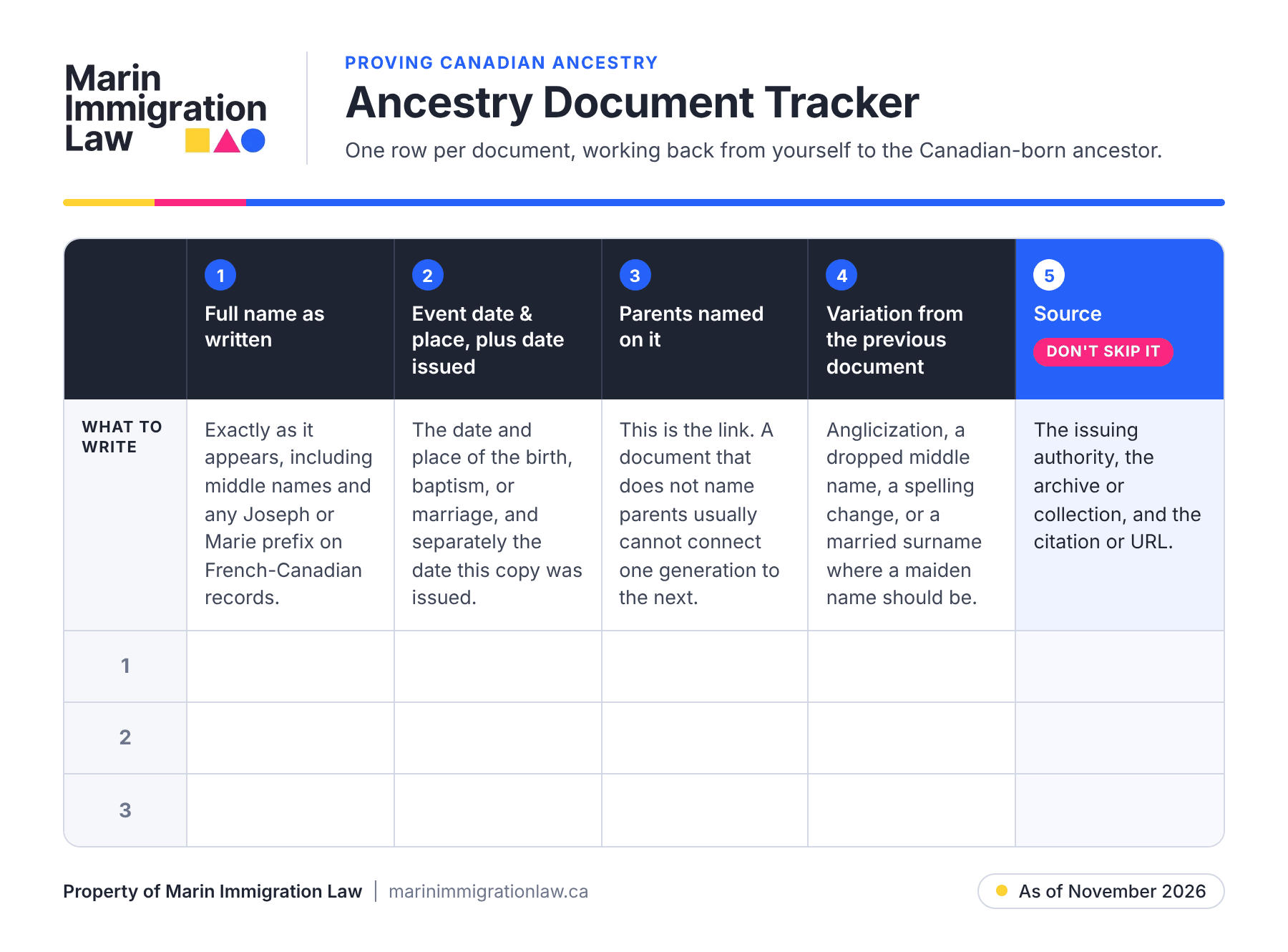
What To Order And What To Find
Anything you cannot find at home can usually be ordered or found, and nearly all of it you can do yourself. The trick is knowing which of the two a record needs, then getting the right version the first time.
The dividing line is roughly 100 years. Inside it, the record is still held by a provincial vital statistics office, so you order it, pay a fee, and the entitlement rules below decide whether you can. Beyond it, the record is generally public: instead of ordering a certificate, you search an archive or database, find the registration itself, and save it with its source.
People routinely pay for a certificate that does not name the parents, or request a record they were never entitled to see, and then wait weeks only to have the incorrect document arrive or to hear that their request was denied.
What follows is how to avoid both.
Where Canadian Records Live
Canadian vital records are provincial, not national. For a recent event, ask the vital statistics office of the province where it happened. For an older one, expect the record to sit in that province's archives or in a church or parish register, and in several provinces you can view it online for free.
Quebec runs its own system, with its own vocabulary and the deepest parish records in the country, so expect a Quebec line to look different from the rest.
The one national source is the census, held by Library and Archives Canada. It is the next-best evidence when a birth record does not exist, because it shows the household together, along with the parents' places of birth.
Ask for the Version That Names Parents
The most useful certificate is the one that lists parents. The short wallet card does not, so you will need the “long form” version. This is not a universal term, so ask what name the issuing office uses. Here are the most common terms below:
- Ontario: a birth certificate with parental information, ordered through ServiceOntario.
- British Columbia: a birth certificate with parental information, ordered through the provincial vital statistics agency.
- Alberta: a birth certificate with personal information and parentage.
- Quebec: a copy of an act rather than a certificate, ordered through the Directeur de l'état civil.
Our downloadable vital records reference list carries the wording, office, and fee for every province and territory, plus where to search for older records.
Who Is Allowed to Order a Record
No province we checked imposes a residency requirement, so living in the United States does not stop you from requesting documents.
What actually limits you is whose record it is: every province restricts a living person's record to that person or close next of kin, as Quebec's rules on who may apply illustrate.
You can order your own birth certificate. You can usually order your parents', as long as they agree to it. You generally cannot order one for a grandparent who is still alive. That is why we ask clients to stop at their grandparents and leave the older generations to us.
Searching Public Records
Older records move to the provincial archives or a public index and open to anyone at roughly a century, varying by province. At that point the record is found, not bought. What you want is the scanned image of the original registration, saved with its citation: the archive, the collection, and the registration or reference number.
The biggest exception is the census, where returns are released after 92 years: the 1931 census opened on June 1, 2023, and 1941 is due in 2033.
- Nova Scotia: the Nova Scotia Archives runs its own free, searchable database, and each name links to the digitized original registration.
- Quebec: BAnQ numérique gives free access to the province's civil status registers, from the earliest colonial records into the early twentieth century. The interface is in French, and the registers are organized by judicial district and parish, so you browse by place and year rather than search by name. The Drouin Collection covers many of the same registers on subscription sites such as Généalogie Québec and Ancestry, and adds name search.
- Ontario: the Archives of Ontario does not run its own search tool. It points researchers to FamilySearch and Ancestry, and their coverage differs: as of November 2026, Ancestry has Ontario births to 1919, FamilySearch only to 1912. For a birth between 1913 and 1919, use Ancestry, which is free through Ancestry Institution at the Archives of Ontario and most public libraries.
On FamilySearch, search by place rather than by name. Open the catalog, enter the province, choose the vital records set for the right years, and browse the digitized index for the year of the event to get a registration number. That number leads you to the registration itself, and our downloadable reference list walks through every step.
The same approach works for the census. If all you have is a name and a town, pull up that town in Library and Archives Canada's census search and read the pages until you find the family. Names are often mis-indexed, but the pages are not.
What To Gather On The US Side
Most of your paperwork is American, and it still does the job. Your own long-form birth certificate and your parents' come first.
After that, the document people most often get wrong is the marriage certificate. We see marriage licenses, abstracts of a marriage, and confirmations of marriage, everything except the certificate itself.
Only the certificate records the name change, and that change is what connects a maiden name on one document to a married name on the next. If a surname shifts anywhere in your line, ensure you order the certificate.
Two more American records earn their place. The naturalization file for the ancestor who emigrated shows when they arrived and when they naturalized, which establishes their status at each point. Census entries listing the entire household, including places of birth, carry weight when no Canadian birth record survives.
As of August 2026, VitalChek handles most states, often around $30 with a 10-day turnaround. Massachusetts and Vermont are straightforward. New York is the hardest state we deal with, so order a New York record early and expect it to take longer than quoted.
What Makes a Document Actually Useful
Not every document that mentions your ancestor helps, and a thin stack of the right records beats a thick stack of the wrong ones.
What follows is how we check a document before it goes anywhere near a file, and what to do about the problems that most often turn up.
The Three Tests
- It names the generation above. A birth certificate that lists parents connects one generation to the next. One that does not, does not. That is the entire reason long form matters.
- It came from the authority that created it. Not a transcription, an index entry, or a family tree, but the actual record from the registrar, parish, or archive, with its citation attached.
- The details agree across documents. Place of birth, surname, and ages consistent from one to the next.
The quick things we check on a client call are:
- Does it say “birth certificate” or “certificate of live birth,” rather than record of birth, abstract, registration, or notification, which are all different documents?
- Does it list the parents?
- Is it legible to the edges?
- Is it a current issue, or a mid-century copy of a copy?
When A Record Does Not Exist, The Search Is The Evidence
If you cannot produce a document issued by the original authority, you explain why and show that you tried: letters and emails to the registrar or parish, the archives you searched, the years you covered, the hours in FamilySearch.
A clerk's letter stating that a search found no record is itself worth submitting.
This documented effort turns “we could not find it” into evidence. For what a complete package looks like, see our post on lessons learned from our recent files.
Common Problems & Why None Of Them Ends A Claim
Almost every file we take has one of these.
The Wrong Certificate
This is incredibly common. For example, New York commonly issues birth registrations and some counties issue abstracts, so people arrive at the call holding everything except the correct certificate.
The good news is that this is fixable for about $30 and a few weeks' wait.
Names That Do Not Match
Many files we see show French names that were anglicized at the border, “Joseph” and “Marie” dropped from Quebec records, or a married surname where a maiden name belongs.
Variation is normal. What resolves it is a bridging document, usually a marriage certificate, plus the surrounding details lining up: both parents' information, places and dates of birth, children, and sometimes a census entry.
There is also a quick test for whether a mismatch matters at all: what is the source of the contradiction? Between two birth certificates, it is a real problem. Between a birth certificate and an obituary or a census age, it is rarely an issue.
A Missing Middle Generation
A missing record is not a missing generation. The person existed, and the law does not require any one particular document to prove it.
Censuses, naturalization files, parish registers, city directories, and marriage records routinely bridge a gap that looks fatal to a family.
It becomes a real problem only when the link cannot be established by any means, or when the records that do exist actively contradict the relationship rather than just failing to confirm it.
Records That Pre-Date The System
Civil registration started at different times: Ontario in 1869, Newfoundland in 1892, and Prince Edward Island not until 1906.
Before those dates there is no government certificate to order. To search earlier, you look at baptism records or local records where the event might have been registered. For Ontario before 1869, the Archives of Ontario lists what survives: baptism records, marriage filings with county courts, and congregation records kept by religious institutions.
For lines in this era, the baptismal record is the gold standard, and we routinely build files from it.
Where The Legal Work Starts
At some point, this stops being a search for documents and becomes a question of law. Knowing where the line is will save you money and time.
Who Gets Which Records
The division follows privacy law, not preference. Because recent records are restricted to the family, you obtain the ones for:
- Yourself
- Your parents
- Your grandparents
Everything older is ours: the research, the legal analysis of which provisions carried citizenship down each generation, the forms, the submission letter, and the filing.
Working with the Marin Immigration Law team includes an in-house professional genealogist, so the research and the legal analysis happen in the same place.
Before their work is filed, the whole package is critiqued separately by another associate on our team who has not met you and whose job is to act as an immigration officer to find potential ways to strengthen your file.
What Wastes Your Money
Every item below costs people money or time for no benefit.
- Do not submit a screenshot or a bare hyperlink. Follow the entry to its source. Order the record from the authority that issued it if it is still inside the ordering window, or save the archive's image with its citation if it is public.
- Do not buy certified copies of everything. They run $100 to $400 each and take months. IRCC accepts color copies with a proper source citation, and in our practice the only certified copy we obtain is the anchor relative's birth record.
- Do not pay for apostilles or certified translations before anyone has looked at your file. Neither is required for color copies.
- Do not send original documents. They will not come back.
- Do not file an incomplete package. A missing photo, an unsigned form, a signature more than 90 days old when IRCC receives the package, or a photo more than six months old gets the whole package returned, costing you your place in the queue, plus the 30 to 60 days it takes to find out. Work from the checklist in IRCC's guide CIT 0001.
- Do not hire an attorney to obtain court orders for records. A copy of the document is sufficient, and we do not do this for any client.
Start With The Drawer In Your Own House
You do not need a lawyer for any of this. Every document on this list can be ordered or found by the person who needs it, many of the older ones for free, and we would rather you knew that than paid someone unnecessarily.
Work through the list, note the five details for each item you find, and keep the sources. If your Canadian ancestor does not anchor a claim, there are other pathways for Americans who want to move to Canada.
Book a Paid Consultation
If you have your own long-form birth certificate, your parents', and any other relevant documents, you have enough for a real conversation.
Book a consultation and bring it all, including the gaps you have. You will get an assessment of where your line actually stands, what is still missing, and what filing would involve, rather than an hour spent working out what you already have at home.
Frequently Asked Questions
What is a long-form birth certificate, and why does it matter?
A long-form birth certificate is the version that names the person's parents, which is what connects one generation to the next. The short wallet card does not include this.
Who can order a birth certificate in Canada?
The person named on it, and close next of kin. There is no residency requirement, so a US-based applicant can order it, but a living person's record stays restricted: you can order your own, a parent's with consent, but generally not a grandparent's.
When do Canadian records become public?
Vital records open at the provincial archives after roughly a century, varying by province. The census is the exception: returns are released after 92 years, which is why 1931 opened in June 2023, and 1941 is due in 2033. Once a record is public, you usually search for it in an archive or online database rather than order a certificate.
Can I find old Canadian birth records for free?
Often, yes. Nova Scotia's archives database and Quebec's BAnQ numérique let you view digitized registrations for free, and FamilySearch is free with an account. Ontario births from 1913 to 1919 are on Ancestry, which is free to use at the Archives of Ontario and most public libraries.
Does IRCC accept photocopies, or do documents need to be certified?
As of November 2026, IRCC accepts color copies with a proper source citation, and we certify only the anchor relative's birth record.
Do I need an apostille or a certified translation?
No, not before someone has reviewed your file, and usually not at all. Neither is required for color copies.
What if a birth record does not exist?
Then the search becomes your evidence: explain why the record cannot be produced, and show the authorities you wrote to, the archives and years you searched, and the time you spent.
This article is general information, current as of its publication date, and is not legal advice for your specific situation. Immigration rules and record-access procedures change. Speak with a qualified professional about your own circumstances.
Disclaimer: This blog is general information only, not legal advice, and may be incomplete or out of date. Laws change often. For advice on your situation, consult a qualified lawyer.
About our team
Five lawyers, a genealogist and a research team, all working on the same files.
Our lawyers have clerked at the Federal Court, decided claims at the Immigration and Refugee Board, served in Canada's foreign service and worked in the immigration groups of leading national firms. Kendra Gaede, our genealogist, chairs the Manitoba Genealogical Society's Research Committee and knows records from Quebec and Acadia to the Prairies. She leads the researchers who trace your family line and find the records that prove it.
2012 to 2016
Cédric Marin, our founder, studies civil law and common law at the University of Ottawa.
2017 to 2022
He clerks at the Federal Court of Canada, decides refugee claims and appeals at the Immigration and Refugee Board, and earns a Master of Laws.
2023
He opens Marin Immigration Law in Ottawa.
2025
Bill C-3 comes into force, and many more families with Canadian roots can claim citizenship.
2026
Four associate lawyers, a genealogist and a research team join, and we move into our office at 280 Albert Street.
Today
About 15 people, in Ottawa and across Canada.

