Over the past several days, Immigration, Refugees and Citizenship Canada (IRCC) has started sending letters, sometimes after a citizenship certificate has already been issued, requiring the holder to surrender the certificate while the department reviews whether the person was actually entitled to it.
These are commonly being called "surrender letters." They are issued under subsection 26(1) of the Citizenship Regulations, which lets the Minister's delegate require the surrender of a certificate where there are reasonable grounds to believe the holder may not be entitled to it. If, after review, the department concludes the person was not entitled, subsection 26(3) directs the Registrar to cancel the certificate.
There has been a lot of commentary suggesting that the problem lies with using websites like Ancestry or FamilySearch, or with not providing certified copies. After reading the letters and reviewing roughly 150 applications affected by the repeal of the first-generation limit, such as those connected to Bill C-3, our view is more specific and, we think, more reassuring.
The issue is not primarily about which website a record came from. It is also not simply about whether every document is certified. More often, the concern is a missing primary record combined with thin supporting evidence and an incomplete, undocumented research trail.
Update (June 23): IRCC reverses the certified-record requirement. Two days after the June 17 change, and following significant criticism, the department appears to have rolled it back. The application guide ("Step 1: Gather your documents") no longer specifies that a certified baptismal certificate is required where a birth certificate cannot be obtained; as of this writing it reverts to the general instruction that applicants provide "clear and easy-to-read colour copies" of their documents. In short, copies are once again acceptable.
This matters in practice. Many baptismal records have been digitized, microfilmed, or indexed, and in a great many cases the original paper register no longer exists in any form that could be certified; it has been misplaced, archived, securely held, or simply lost. Where the only surviving record is a microfilm or a digitized image, a certified copy can be impossible to obtain, and a short-lived requirement to certify these records would have put a meaningful number of legitimate applications out of reach.
We still encourage clients to obtain certified copies of the anchor relative's documents wherever possible, and the position could of course change again. IRCC could reinstate a certification requirement in the future. But it is genuinely helpful to have clear confirmation from the department that copies of original documents are acceptable. It is also worth repeating where these records actually live: Ancestry and FamilySearch are hosting platforms, where archives post their holdings to make them accessible (not the source itself). Whenever possible the citation should point back to the original archive; in Quebec, that means returning to the BAnQ website and locating the original document there (explained further below). For us, this confirms the approach we have developed over the past six months: properly cited copies of original documents can be accepted.
Update (June 17): Since speaking with David Baxter of The Canadian Press, IRCC has updated its application guide (see "Step 1: Gather your documents"). IRCC has now confirmed that when a birth certificate cannot be obtained, alternative proof can include a certified baptism record.
This is significant, because a birth certificate cannot be obtained for nearly every person born before 1900, since birth certificates only began to be issued around that time. It is worth stressing that IRCC specifies the record must be issued by the original authority "and can include" a certified baptismal certificate. It remains to be seen whether links from BAnQ will suffice, or whether the agency will now need to certify tens of thousands of additional certified copies. It also remains to be seen whether IRCC will continue to allow applicants in Quebec to rely on baptism records in cases where a birth certificate can be ordered from the province, even for births before the 1900s, when accompanied by the certified baptism certificate.
In our practice we have always requested certified documents, though we have sometimes proceeded with applications on the basis of clear copies alone.

What the letters said
The letters we have reviewed give two related reasons. First, that the documentation submitted in support of the proof of citizenship application did not come from the original source authorities responsible for creating or maintaining the historical record, such as a civil registry, a vital statistics agency, or another authorized government body. Second, and this is the heart of it, that where source documents are not available or cannot be obtained, the applicant must provide both:
- a written explanation outlining why the source document cannot be obtained; and
- evidence of the efforts made to obtain it, such as correspondence with issuing authorities or confirmation that the records are unavailable.
When neither of those is in the file, IRCC may treats the package as unproven and asks for the certificate back. This is the "two prong test," and it is the through line in almost every letter we have seen.


The Ancestry question, in plain terms
A record being found on Ancestry or FamilySearch does not, on its own, make it an unofficial or invalid document. The original records remain in the custody of the government and public archives. These institutions have simply digitized their holdings and made them available to the public through Ancestry and FamilySearch, which host and provide access to the images.
In Ontario, the Archives of Ontario directs applicants to obtain digitized birth registrations through Ancestry and FamilySearch for births in roughly the post-1869 period up to the 1920s. In Quebec, Bibliothèque et Archives nationales du Québec (BAnQ) digitized its collection and shared it with the same platforms. In other words, the provincial archives themselves point people to these sites. The record sitting on Ancestry is frequently the digitized image of the official provincial registration, hosted there on the archive's behalf.
The practical fix is to stop treating these platforms as the source and start treating them as a finding aid that points back to the original source authority. The image you pull from Ancestry should be tied back to the registration it reproduces, with a full citation: the repository or archive, the parish, church, or vital statistics office, the record set, the book, film, page, and entry number, and the date you accessed it. A screenshot or an index extract on its own is a clue. The same record, properly cited back to the authority that created it, is evidence.
For example, nearly every BAnQ document available on Ancestry can also be found through the original archival source. One example is:
"Trois-Rivières Wesleyan Methodist Church, 1831-1920, Archives nationales à Trois-Rivières, Fonds Cour supérieure. District judiciaire de Trois-Rivières. État civil, (04T,CE401,S47)."
That same record is accessible directly through the BAnQ website as well as on Ancestry. The platform is merely another route to the identical document the archive holds.
As a further illustration, some archivists will tell you that their entire collection is already online on FamilySearch and that they no longer offer in-person appointments to consult it.
Certified copies remain the gold standard, and we always tell clients that. At the same time, it is worth noting that IRCC’s own document checklist, CIT0014, section 3, “Proof that a parent is Canadian,” asks for a colour copy of the document, not a certified copy. In other words, the current instructions, including those from provincial archives, genuinely do direct applicants to online sources.
Where you can obtain a certified copy of a birth certificate or source record, order it. Where you cannot, the two-pronged test is what carries the file.
In our practice, we usually provide a colour copy of the document and also order the certified record. However, certified records can take months to arrive. For that reason, we submit the application with the colour copy, as contemplated by the document checklist, and then update the application once the certified copy is received.
Why did those files receive the surrender letter?
It is worth being candid that no one outside IRCC yet knows precisely what tipped each of these files into review.
In a recent post on the surrender letters, Hayer Law Office made the same observation about the department’s apparent wariness toward records pulled from sites like Ancestry and FamilySearch, noting that “whether there is any connection ... remains to be seen.”
We agree.
At this stage, it is genuinely unclear why any one applicant was flagged, and the letters themselves do not always say. Some commentary assumes that the concern must relate to the person born in Canada: for example, whether that person’s Canadian birth record was sufficient, properly sourced, or properly authenticated. But that may not be the whole issue. In some files, the concern could just as easily relate to the next link in the chain: the child of the person born in Canada. In other words, the evidentiary problem may not be “Was the Canadian-born ancestor really born in Canada?” It may be “Has the applicant properly proven the parent-child connection through each generation?”
Was the copy that was submitted unclear, cropped, or illegible? Was a document from one of those sources provided, but not a birth record; for example, a marriage record or census return standing in where a birth registration was expected?
A file that pairs a properly cited record with documented search efforts and a written proof argument is stronger whichever explanation turns out to be the operative one.
When the record does not exist: the two prong test in practice
Some applicants may not have been able to find a baptism record, a birth index, or a birth registration, often in pre 1900 cases, and so they relied on a preponderance of other evidence to show the ancestor was born in Canada, drawing on census returns, border crossing records, and similar documents. They might have done this for others in the lineage. We set out the evidence hierarchy for these pre-1900 births in our guide to citizenship by descent through a great-grandparent.
The trouble was twofold: the research done to find the primary record was not fully documented, and the substitute documents did not meet the standard IRCC was looking for.
So if a civil birth record cannot be obtained, the submission should contain a short, explicit explanation that addresses four things:
- why the civil birth certificate or source record is unavailable;
- what efforts were made to obtain it;
- why the alternative record is reliable; and
- how the alternative proves the parent to child or citizenship link.
For the second point, "efforts" needs a paper trail. That means the emails and request forms sent to vital statistics or to the archive, the confirmation or response you received, any negative search letter or access denial, screenshots of ordering restrictions, receipts, dates, and the names of the offices contacted. The goal is a file that shows, on its face, that the search was real and reasonable.
One caution from our own recent experience is worth flagging. A letter from a municipality, a church, or a province stating that it searched and holds no record is often not sufficient on its own. In just the last six months we have sometimes located records that those same authorities first claimed were unavailable.
For context, of our files that have gone through urgent processing, roughly a dozen have been approved. In several of those we did not submit certified copies, and in some the underlying record had been located on Ancestry or FamilySearch. None of those generated a surrender letter. The common thread among recipients, in our experience, is a missing birth record and a failure to satisfy the two prong test, not the platform a record happened to live on.
The Genealogical Proof Standard, applied to a citizenship file
The framework that ties all of this together is the Genealogical Proof Standard, which professional genealogists use to decide when a conclusion is sound. It has five elements, and they map almost directly onto what IRCC is asking for:
- Conduct a reasonably exhaustive search. This is the answer to the two prong test. It is also why a single "no record" letter does not end the matter.
- Create a citation for every source used. This is what turns an Ancestry image into evidence rather than a screenshot.
- Analyze and correlate the collected information. No single substitute record needs to carry the whole claim; the records work together.
- Resolve any conflicts or contradictions. A name spelled three ways, or two different birth years, has to be addressed head on, not ignored.
- Write your conclusion. This is the written explanation and the proof argument that should accompany the package.
If a package contains the record, the source authority, certification where possible, and documented efforts where the record is unavailable, it satisfies all five. "Record only" submissions, with no citation, no analysis, and no research trail, are exactly the kind that are now drawing scrutiny.
How to build the proof argument
When there is no direct birth record, the proof argument is built by analyzing the evidence rather than simply listing documents. Genealogists break this into three steps, and it is a useful discipline for any submission.
Start with the source. Sources are documents, registers, publications, artifacts, people, or websites, and they fall into three types: an original record (the registration as first created), a derivative record (a later copy, transcription, or index), or an authored narrative (someone's account or write up). An original always carries more weight than a derivative, which is precisely why you tie the Ancestry image back to the original registration it reproduces.
Next, weigh the information in the source by how close the informant was to the event. Primary information comes from someone with firsthand knowledge recorded at or near the time, secondary information is secondhand or recorded long after (e.g. place of birth in a census), and some information is simply undetermined (e.g. a death record can be inconsistent since the person is no longer alive to attest to their place of birth). A baptism recorded by the officiating priest days after the birth is strong primary information about that birth, even though it is not the civil registration.
Finally, classify the evidence, meaning the relevance of that information to the actual question of where and when the ancestor was born. Direct evidence answers the question explicitly. Indirect evidence is relevant but not explicit, so it has to be combined with other records to support a conclusion. Negative evidence is the meaningful absence of a record where one would normally expect to find it.
In practice, this is how a file with no birth certificate is still proven. A baptismal register (an original source with primary information) places the birth in a Canadian parish. A census returns a few years later (a derivative source with secondary information) shows the family living in Canada with the child's age consistent with that birth. A border crossing record adds another consistent data point. Individually, each is indirect. Correlated, analyzed, and written up, they can establish the Canadian birth on a balance of probabilities, which is the standard that applies. Add the documented efforts to find the missing civil record, and you have answered both the two prong test and the Genealogical Proof Standard at once.
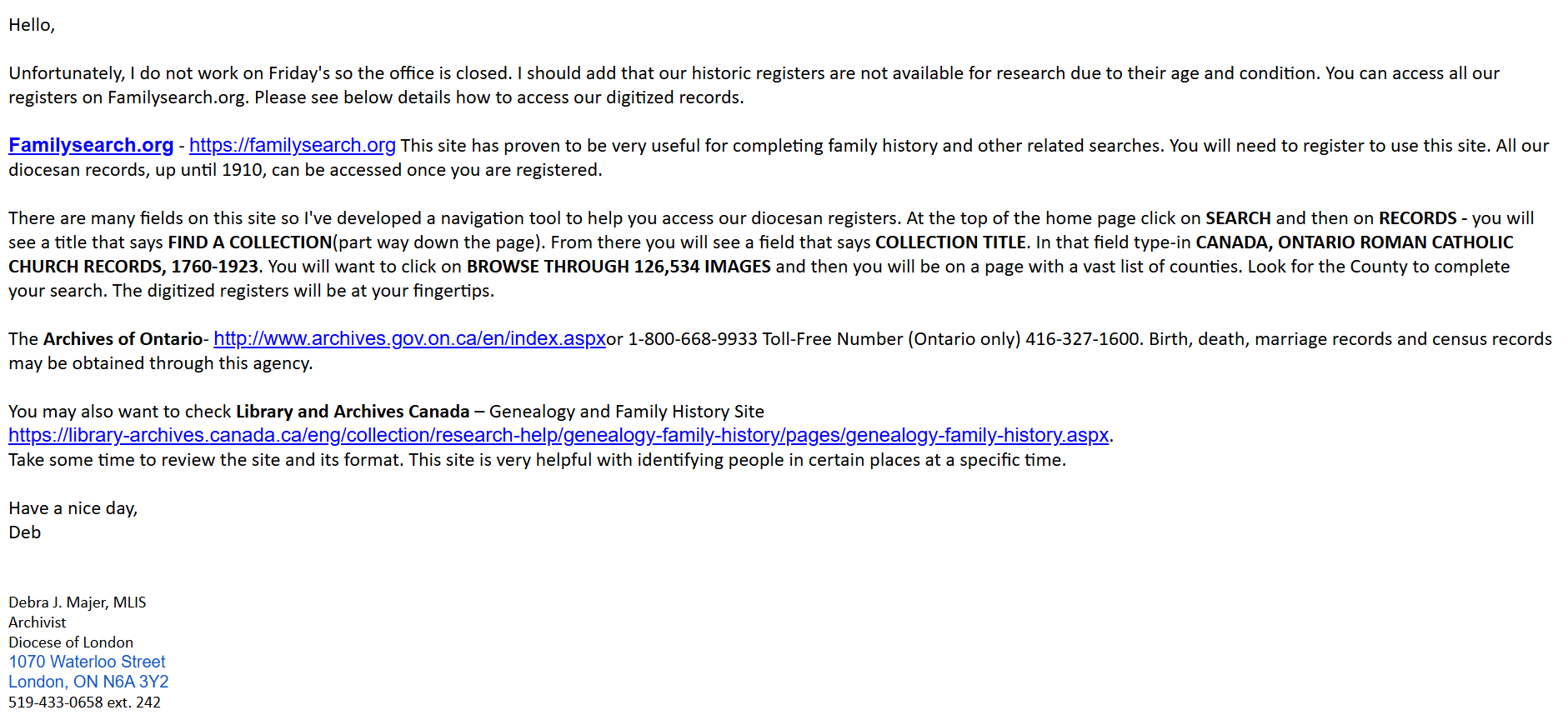
In older cases, where no civil birth certificate, baptismal record, or birth registration can be located, provide any available birth index, register reference, archive response, or search result showing that the record was sought. For example, in recent research, the Diocese of London confirmed the following, which we included in our application:
“All our records in the collection can be accessed and found on Familysearch.org. If the records are not on Familysearch.org that means they don't exist or no longer exist. There are no London records dating back to 1825 as the London church did not begin until 1834 and the earliest records date back to 1843. The earliest records for St. Thomas date back to 1830 but they are partial records with limited information. The St. Thomas records officially begin in 1839.”
That combination (source analysis, correlated evidence, and documented efforts to locate the missing primary record) answers both the two-pronged test and the Genealogical Proof Standard at once.
These are the broad strokes of genealogy research as set out by Evidence Explained: Citing History Sources from Artifacts to Cyberspace by Elizabeth Shown Mills.
Our practice
If any of this feels daunting, you do not have to work through it alone. Much of what is described above, the reasonably exhaustive search, the citations that tie each record back to its source authority, and the written proof argument, is the work our small team does every day.
Our in-house genealogist, Kendra Gaede, focuses specifically on Bill C-3 citizenship by descent and knows pre- and post-Confederation Canadian records well, from Ontario and Quebec through the Maritimes and the Prairies. She works alongside our research assistant and PhD candidate, Simon Malépart, who brings careful, multilingual archival research to the harder-to-trace generations. Our principal lawyer, Cédric Marin, draws on his background at the Federal Court and the Immigration and Refugee Board to build the legal submissions around that research. We do not claim to have every answer, and both the law and IRCC's approach in this area are still taking shape, but we are always glad to talk through where a file stands and what a well documented package might look like for your family. You can read more on our Canadian citizenship by descent page.
The takeaway
In my view, IRCC is not saying that online genealogy is off limits. It is saying that a record, on its own, is no longer enough.
Going forward, a strong package has five parts. You need the record itself. You need to tie that record back to the authority that created it, such as the vital statistics office or the parish. You should provide a certified copy wherever you can obtain one. Where the record cannot be obtained, you need to show the efforts you made to find it. And you need a written argument that walks through the evidence and resolves any conflicts in it.
For families pursuing citizenship by descent, the good news is that all of this is within reach. The records that prove these claims usually exist, and even when a primary record is missing, a careful and well reasoned package can still carry the file. The real work lies in searching thoroughly and explaining your reasoning clearly, and that is exactly the work that protects a certificate once it is issued.
Related reading. Lost Canadians explained explains who the first-generation limit excluded and how Bill C-3 changed that, five things we learned from our access to information request shows how IRCC is applying the new rules in practice, and lessons learned from our recent citizenship by descent files collects the document problems we see most often. Before anyone signs, check the form version in IRCC updates the CIT 0001 and CIT 0014.
For the proof and evidence questions that come up most often on these files, see our citizenship FAQ.
Disclaimer: This blog is general information only, not legal advice, and may be incomplete or out of date. Laws change often. For advice on your situation, consult a qualified lawyer.


.png)