
- A certified copy from BAnQ took our firm about four months from order to arrival in 2026. About 88% of that time was the wait for BAnQ's payment request.
- For records held at BAnQ Montréal, the payment request came 98 to 109 days after ordering (median 105 days), with no sign yet of it getting faster.
- BAnQ's own request numbers suggest it received about 20,000 requests between March and November 2026, peaking in late June after IRCC briefly called for certified baptismal records.
- Since September BAnQ has been clearing requests a little faster than new ones arrive, so the wait may start to shrink slowly in 2027.
The short answer
In 2026, a certified copy of a Quebec baptism, marriage or burial record from Bibliothèque et Archives nationales du Québec (BAnQ) took our firm about four months from order to envelope. Most of that time is spent waiting in BAnQ's queue for the payment request. Once we pay, the copy usually reaches our Ottawa office in one to three weeks.
We know BAnQ's process well because we use it constantly. Since March 2026 our firm has filed 58 certified-copy requests with BAnQ for clients claiming Canadian citizenship by descent under Bill C-3, about $20,000 in BAnQ documents ordered this year. We believe that makes us one of BAnQ's largest clients for Quebec civil records. This post shares what we measured: how long each step took, whether it is getting faster, and what BAnQ's own request numbers tell us about how many people are ordering records right now.
By the numbers
| What we measured | Figure |
|---|---|
| BAnQ requests our firm filed, March to November 2026 | 58 |
| BAnQ documents our firm ordered in 2026 | About $20,000 |
| Requests BAnQ received between our first and latest order | About 20,000 |
| Typical wait for a payment request, BAnQ Montréal | 105 days |
| Fastest payment request | Same day (Rimouski) |
| Longest wait for a payment request so far | 140 days |
| Share of the total wait spent in BAnQ's queue | 88% |
| Fastest arrival after paying | 5 days |
| Price of one certified copy | $350 |
| Payment requests BAnQ sends per business day, since September | About 100 |
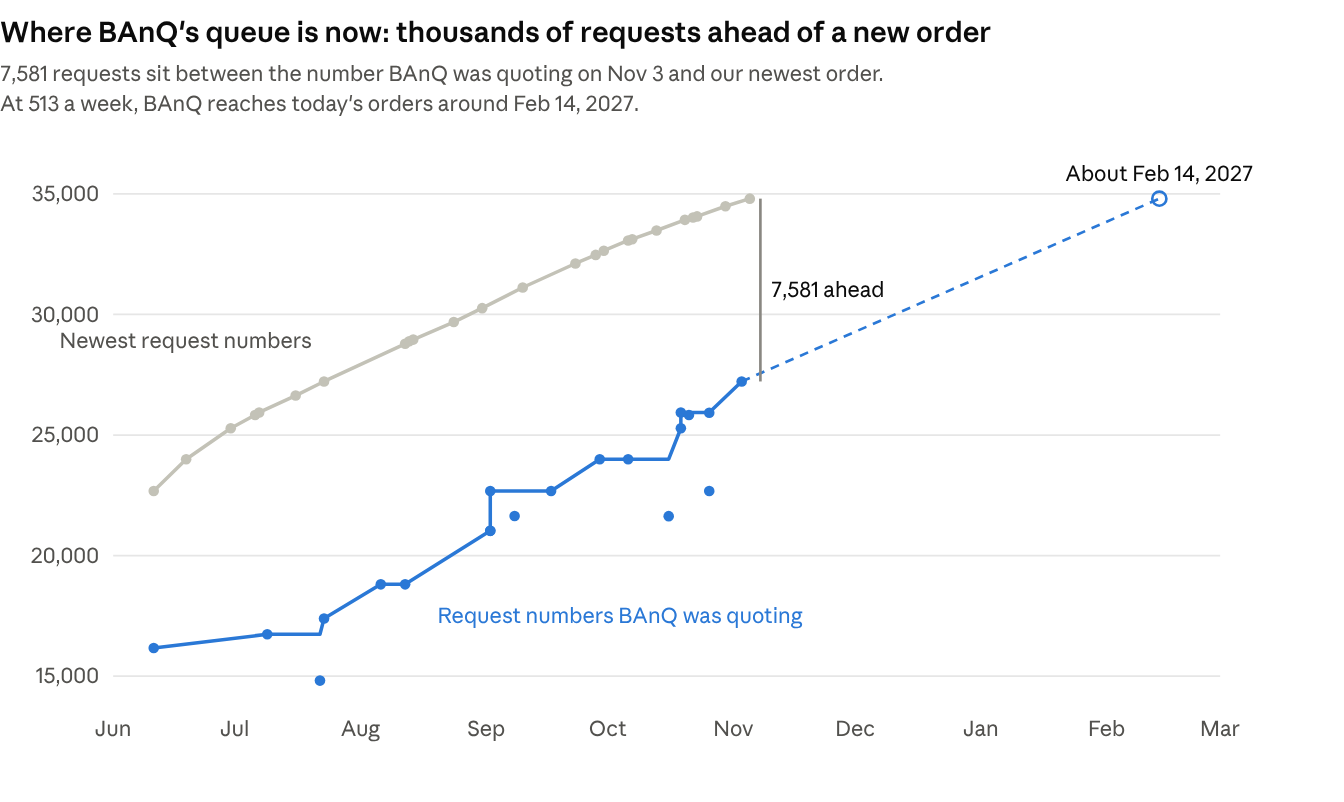
| Requests ahead of an order placed today | About 7,600 |
| Certified copies BAnQ mailed us twice | 1 |
How a BAnQ order works
BAnQ holds Quebec's civil registers (baptisms, marriages and burials) that are more than 100 years old. Records less than 100 years old stay with the Directeur de l'état civil. A certified paper copy from BAnQ is ordered through its online reproduction request form, and every order moves through the same five steps:
- Order. You submit the form with the person's name, the date of the act, the parish and the archive centre. BAnQ emails an automatic acknowledgement with a request number. The message currently says that, because of an exceptional number of requests, BAnQ cannot estimate a processing time.
- Payment request. When an archivist reaches your request, BAnQ emails a quote ("devis") with a payment link. In our experience this is the long wait.
- Payment. You pay online and BAnQ emails an invoice ("facture") confirming payment. Our certified copies cost $350 each, plus a few dollars of postage to Ontario. The payment link expires, so pay promptly.
- Certification. An archivist certifies the copy, usually one to four days after payment, judging by the dates stamped on the copies we received.
- Mail. BAnQ mails the certified paper copy. Only paper copies are certified.
BAnQ's vital records page and its French civil records page explain what it holds and how to search the registers online before ordering.
How long each step took
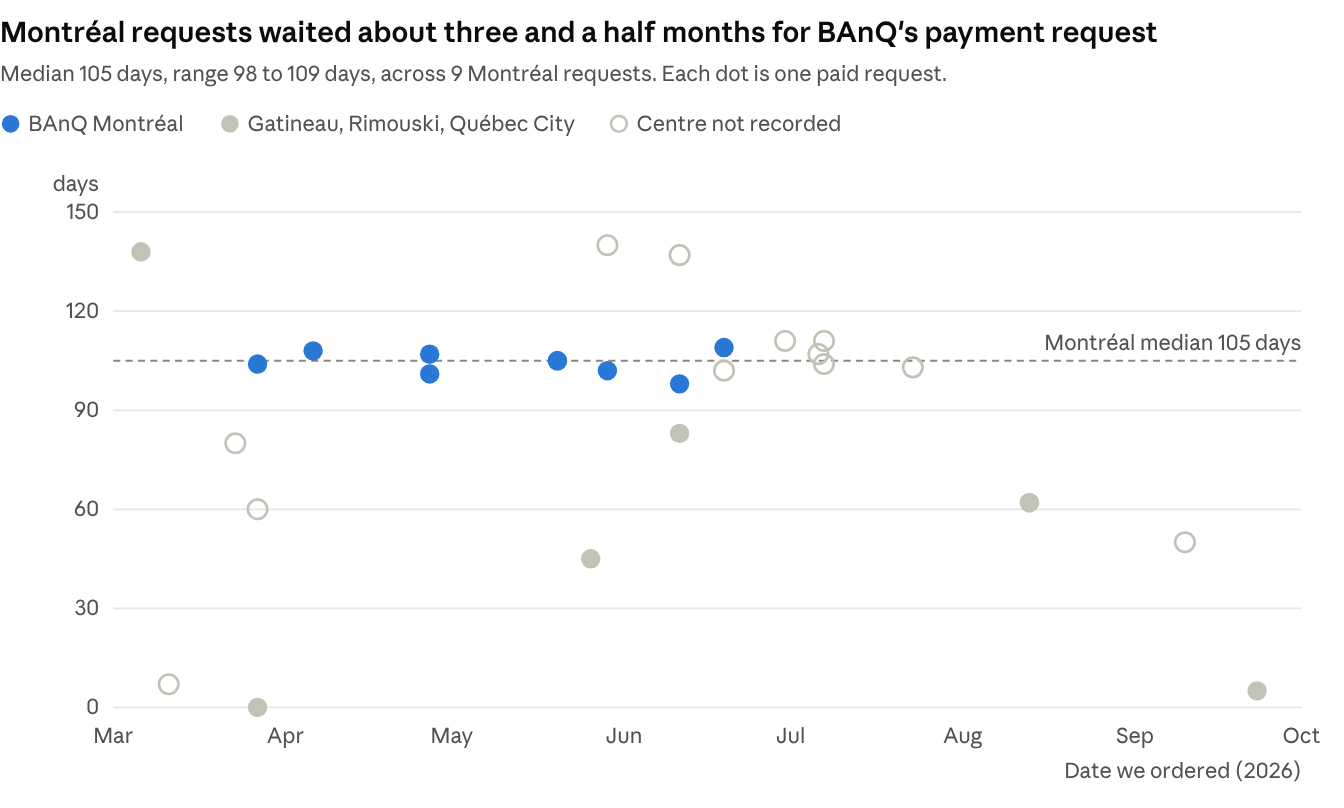
The wait for BAnQ's payment request is the whole story. For records held at BAnQ Montréal it was remarkably steady, at about three and a half months, no matter when we ordered.
Once the payment request arrives, the rest is quick:
| Step | Typical (median) | Range in our sample |
|---|---|---|
| Order to payment request, Montréal | 105 days | 98 to 109 days |
| Payment request to payment | Same day | 0 to 10 days |
| Payment to copy in our office | 13 days | 5 to 21 days |
| Order to copy in hand, all centres | 115 days | 65 to 125 days |
BAnQ's invoices warn that mail can take four to eight weeks. Our copies to Ottawa took one to three weeks.
One Gatineau request taught us a lesson the hard way. It got its payment request within a week, but we paid late, the payment link lapsed and BAnQ cancelled the order. BAnQ kindly reopened it. Copies that arrived in late September also took a little longer than usual because we were moving offices that week.
Is BAnQ getting faster?
Not yet. Every Montréal request we placed between April and July waited between 98 and 109 days for its payment request. A request placed in early April and one placed in late July waited about the same time.
Some of our newer requests look faster at first glance. They are not. Three of the fastest went to regional archive centres, which move quicker, and the Montréal requests we placed in August and September simply have not come back yet. As of early November, eight of the ten requests we placed in August had already waited 67 to 86 days with no payment request.
There is a reason for cautious optimism. Since early September, BAnQ has been issuing payment requests a little faster than new requests come in (see the next section). If that holds, the line ahead of each new order will shrink, and the wait should drop by about six days each month. At that pace, getting from three and a half months down to under two would take until mid-2027.
How many requests BAnQ is getting
BAnQ gives every reproduction request the next number in a single sequence, and it emails that number back within minutes. That makes every order we place a small window into BAnQ's workload. Our first 2026 order was number 14,816 on March 6; our order on November 5 was number 34,802. Roughly 20,000 requests reached BAnQ in between, about 570 a week. Ours were 58 of them, about 1 in every 345.
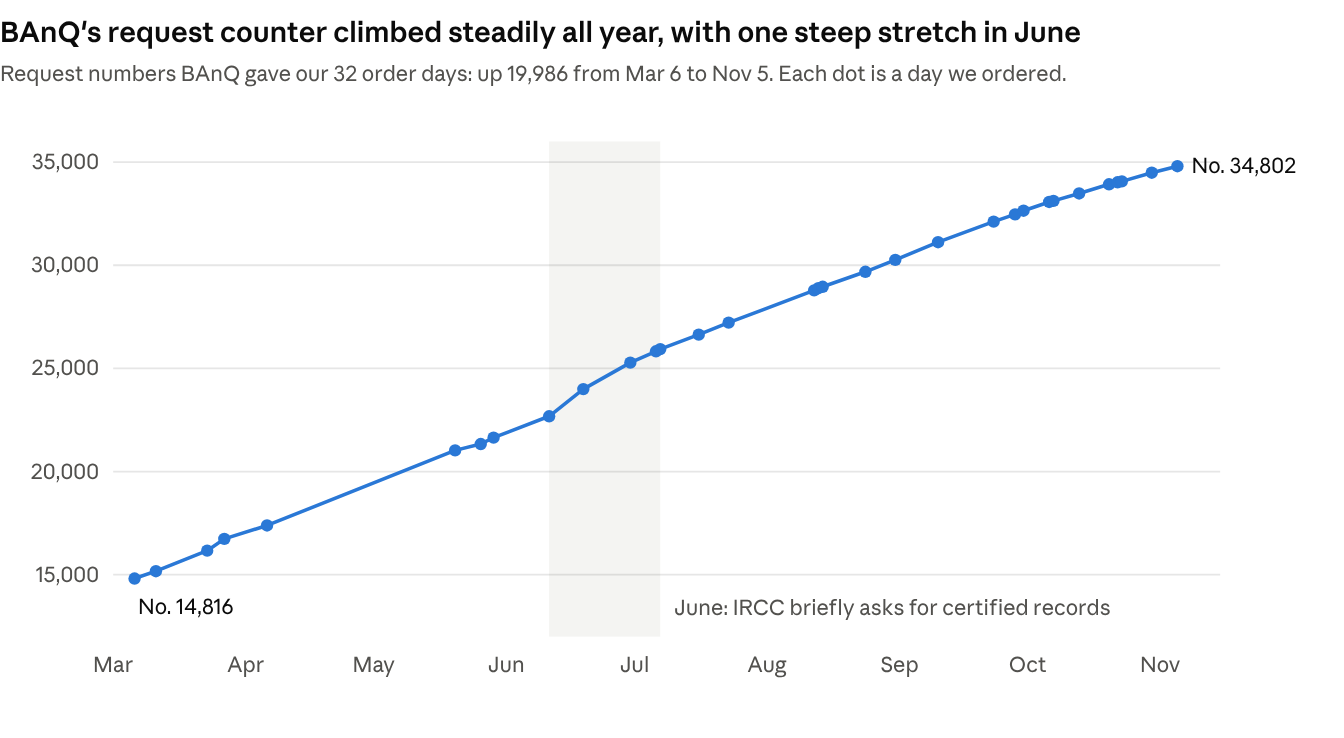

Why the June spike? In mid-June, IRCC changed its application guide to ask for a certified baptismal record whenever a birth certificate could not be obtained, at the same moment its first surrender letters were reaching certificate holders. The requirement was walked back within days (we covered it in Surrender Letters and the Citizenship Proof Standard), but the message had landed. Families who had been relying on online copies rushed to order certified ones, and orders that would have trickled in over the summer arrived within a few weeks.
Why does the rest of the year look so even? We think two kinds of demand are hiding behind one flat line. First-time demand was probably highest early in 2026, right after Bill C-3. If BAnQ restarts its numbering every January, which we have not been able to confirm, about 14,800 requests arrived before March 6, close to 1,600 a week, nearly three times today's pace. That first wave has eased. A second wave has taken its place: IRCC is increasingly asking applicants for a Quebec birth certificate from the Directeur de l'état civil, and in our practice that application goes in with the BAnQ certified copy. Families who never ordered a certified copy are ordering one now. October, at about 400 a week, was the quietest stretch we measured.
We can also see where BAnQ is in its queue. In early November it was sending payment requests for orders numbered around 27,000, placed in late July. That leaves roughly 7,600 requests ahead of an order placed today. Since September, BAnQ has worked through about 510 requests a week, a little more than the roughly 400 a week now coming in. That gap is why we expect the wait to start shrinking slowly.
That pace also puts our August visit in perspective. When our team toured BAnQ, staff mentioned roughly 10 new hires each handling 50 to 70 requests a day, which would be 500 to 700 a day. Our own orders suggest BAnQ issues closer to 100 payment requests per business day across the whole service, so those per-person figures could not all have been right. We have added a correction to Inside BAnQ: Our Team's Visit to Quebec's National Archives.
What this means for a citizenship by descent application
If your Canadian-born ancestor was baptized in Quebec, plan on four months or more for a BAnQ certified copy. Ordered today, a Montréal request would likely get its payment request around mid-February 2027 and arrive in early March.
Waiting for the certified copy before applying is rarely necessary. Our practice is to file the proof of citizenship application with a copy of the act taken from the State's copy of the register held at BAnQ, with the BAnQ numérique link to the image. We order the BAnQ certified copy at the same time, send it to IRCC through its web form when it arrives, and then use it to apply to the Directeur de l'état civil for a Quebec birth certificate. Some IRCC officers ask for that certificate and others do not, so we prefer to have both on the way.
This is our firm's general practice and commentary, not legal advice for your file. Every lineage is different, and the right sequence depends on your documents and your timeline.
Tips for ordering from BAnQ
- Find the record first. Search the registers on BAnQ numérique and attach the image and a citation to your request. A precise date, parish and archive centre saves the archivist time.
- Name the right archive centre. Requests held in Gatineau, Rimouski or Québec City often came back faster for us, sometimes within days, though not every time. Montréal consistently took about three and a half months.
- Watch your inbox for the payment request. The quote's payment link has a deadline. We had one request cancelled before the deadlines BAnQ itself gave, and had to ask BAnQ to reopen it.
- Pay once per record. Check whether you already have an order open for the same act before you file a new one. Each certified copy costs $350.
- Keep your mailing address current. BAnQ mails to the address on the original form, even if you move while you wait.
- Keep the request number. It is the only reference BAnQ uses, and it is the fastest way to follow up.
How we measured this
We pulled every BAnQ acknowledgement, payment request and invoice email from our firm's inboxes, and matched each request to the day its certified copy arrived at our office from our mail log and file notes. The sample is 58 requests placed between March 6 and November 5, 2026. Of these, 28 have been paid and 21 copies are in our office, 18 with a logged arrival date.
A few limits apply. Our sample is small, and most of our records sit in Montréal. Mail times in late September were stretched by our own office move. The volume estimate assumes BAnQ uses a single counter for its reproduction requests, which may include requests for more than civil records. BAnQ has not published processing times, and these figures are our observations, not BAnQ's.
This article is general information about our experience. It is not legal advice. If you are considering a citizenship by descent claim, book a consultation to discuss your own file.
Sources
Disclaimer: This blog is general information only, not legal advice, and may be incomplete or out of date. Laws change often. For advice on your situation, consult a qualified lawyer.
About our team
Five lawyers, a genealogist and a research team, all working on the same files.
Our lawyers have clerked at the Federal Court, decided claims at the Immigration and Refugee Board, served in Canada's foreign service and worked in the immigration groups of leading national firms. Kendra Gaede, our genealogist, chairs the Manitoba Genealogical Society's Research Committee and knows records from Quebec and Acadia to the Prairies. She leads the researchers who trace your family line and find the records that prove it.
2012 to 2016
Cédric Marin, our founder, studies civil law and common law at the University of Ottawa.
2017 to 2022
He clerks at the Federal Court of Canada, decides refugee claims and appeals at the Immigration and Refugee Board, and earns a Master of Laws.
2023
He opens Marin Immigration Law in Ottawa.
2025
Bill C-3 comes into force, and many more families with Canadian roots can claim citizenship.
2026
Four associate lawyers, a genealogist and a research team join, and we move into our office at 280 Albert Street.
Today
About 15 people, in Ottawa and across Canada.